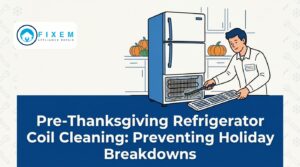
The Silent Threat to Your Thanksgiving Prep
At FixEm Appliance Repair, we know that as the calendar flips to Pre-Thanksgiving November, the focus naturally shifts to planning menus, finalizing guest lists, and preparing for the biggest grocery haul of the year. However, in our experience serving the local area, this is also the exact time to prioritize pre-Thanksgiving refrigerator coil cleaning: preventing holiday breakdowns before they ruin your family meal. The days immediately leading up to the holiday see a massive, predictable surge in appliance failures, leaving homeowners scrambling for emergency help while specialized groceries sit at risk of spoiling.
A pattern we see often is that this spike in breakdowns is rarely a coincidence. The root cause is almost always a combination of heavy grocery loading and months of neglected routine maintenance. When our technicians diagnose a refrigerator system that has failed right before a major event, the underlying trigger is usually restricted airflow at the coils combined with an overwhelming amount of new, room-temperature food. Taking action now to address these hidden vulnerabilities ensures your kitchen remains fully operational when you need it most.
Addressing this maintenance gap is a core part of our professional appliance repair services. By understanding exactly why this specific time of year is so dangerous for a refrigerator’s compressor, you can take the right proactive steps to protect your kitchen. The mechanics behind these failures are straightforward, but the consequences of ignoring them can disrupt your entire holiday.
Understanding Sudden Thermal Load and Compressor Strain
Our technicians often explain to customers that to understand why refrigerators fail during the holidays, you first have to understand how they actually cool your food. A refrigerator does not pump cold air into the cabinet; rather, it absorbs heat from the items inside and pumps that heat out into your kitchen. The measurement of this heat is called “thermal load.”
The Mechanics of Heat Removal
Under normal daily conditions, your refrigerator maintains a steady state. You might open the door to grab milk or put away a few leftovers, introducing a small amount of heat. The compressor kicks on, circulates the refrigerant to absorb that minor heat, and shuts off a short time later. This is the normal cycling process.
However, the holiday grocery run introduces a sudden thermal load increase. When you load a massive 20-pound unchilled turkey, a dozen room-temperature side dishes, and multiple warm beverages into the fridge all at once, you are introducing an enormous amount of heat into the enclosed space. The internal temperature spikes, and the thermostat signals the compressor to turn on and stay on.
To remove this sudden influx of heat and maintain how cold your refrigerator should be, the compressor is forced into overdrive. Continuous run cycles are perfectly normal for short bursts when a system is clean and functioning correctly. The mechanical components are designed to run for extended periods to bring a large batch of groceries down to safe storage temperatures. The danger arises when the heat being absorbed from the food cannot efficiently escape the system.
| Condition | Thermal Load Level | Compressor Behavior | Risk of Overheating |
|---|---|---|---|
| Normal Daily Use | Low to Moderate | Cycles on and off regularly | Very Low |
| Weekly Grocery Trip | Moderate | Runs slightly longer to stabilize | Low |
| Thanksgiving Haul | Extreme (Sudden thermal load increase) | Runs continuously for hours | High (if coils are dirty) |
How Dirty Condenser Coils Trigger Catastrophic Failure
The heat absorbed from your Thanksgiving groceries has to go somewhere. That is the specific job of the condenser coils, which are typically located either underneath the refrigerator behind a kick guard or on the back panel of the unit. As the compressor pressurizes the heated refrigerant, it pushes it through these coils, allowing the heat to dissipate into the surrounding air of your kitchen.
The Insulating Effect of Dust and Debris
When our team pulls units away from the wall during routine checkups, we routinely find that condenser coils naturally attract dust, pet hair, cooking grease, and general floor debris over the course of a year. Because a fan actively pulls air across these coils to aid in cooling, they essentially act as a filter, trapping airborne particles. Eventually, this debris forms a thick, felt-like blanket over the metal tubing.
This blanket of dust acts as a powerful insulator. When a sudden thermal load increase occurs and the compressor begins working overtime to cool your holiday groceries, the heat travels to the condenser coils but cannot escape through the layer of grime. The heat becomes trapped inside the sealed system.
This creates a dangerous compounding effect. The compressor continues to pump harder and run longer because the interior of the fridge is still warm, but the heat cannot be rejected into the room. The compressor itself begins to overheat drastically. This specific combination—a massive influx of warm food paired with choked airflow at the condenser—is the exact trigger for many catastrophic holiday compressor failures we see. When the compressor overheats to the point of mechanical failure, the entire cooling process stops dead, requiring urgent refrigerator repair to restore the appliance.

The Hidden Threat of Rising Ambient Kitchen Temperatures
The internal mechanics of your refrigerator are only half of the equation. The environment surrounding the appliance plays a massive role in how effectively it can cool. Refrigerators rely on a temperature differential to function; they need the air outside the unit to be cooler than the hot refrigerant passing through the condenser coils.
As late fall arrives and indoor heating systems turn on, ambient kitchen temperatures naturally rise. This puts additional external strain on a compressor that is already struggling with dirty coils. The air being pulled across the condenser is now warmer than it was just a few weeks prior, which reduces the efficiency of the heat transfer process.
Furthermore, Pre-Thanksgiving November is characterized by early holiday baking, simmering stovetops, and multiple people gathering in the kitchen. All of this activity generates significant ambient heat. If your refrigerator’s coils are blanketed in dust, and the surrounding kitchen air is unusually warm from the oven and furnace, the system is left with zero margin for error. The compressor is forced to work against the heat of the groceries inside, the insulation of the dust below, and the warm ambient air outside. This perfect storm of thermal physics is why proactive maintenance is critical before the heavy cooking begins.
Warning Signs Your Refrigerator is Struggling to Cool
In our years of handling holiday appliance disasters, we’ve found that identifying a struggling refrigerator before you load it with a massive holiday grocery haul can save your meal and your sanity. Often, a system will show subtle signs of distress before a complete compressor failure occurs. If your unit is already compromised, it will not be able to handle a sudden thermal load increase.
Watch and listen for these specific warning signs in the weeks leading up to the holiday:
- Continuous compressor operation: A healthy refrigerator cycles on and off. If you notice the low hum of the compressor running constantly for hours on end without stopping, the system is struggling to reject heat.
- Excessive heat radiating from the cabinet: While the area near the floor or the back of the fridge will naturally feel slightly warm, it should never feel hot to the touch. Excessive heat radiating from the kick plate indicates trapped heat at the coils.
- Inconsistent internal temperatures: If your milk is spoiling faster than usual, or if you notice soft spots in your ice cream, the system is failing to maintain its set point.
- Unexpected frost buildup: Ice accumulating on the back wall of the fresh food section or around the freezer vents often points to airflow issues or a sealed system struggling to regulate itself, which may eventually require freezer repair.
- Loud or unusual noises: A clicking sound, a loud buzzing, or a harsh rattling from the back of the unit can indicate a compressor that is overheating and struggling to start or run properly.
If you notice any of these symptoms, the appliance is already operating on borrowed time. Adding the stress of holiday groceries to a unit exhibiting these signs is highly likely to trigger a complete shutdown.
The True Cost of Neglecting Seasonal Appliance Prep
Running a compromised refrigerator does more than just risk a breakdown; it actively wastes energy and drives up household expenses. According to data from the U.S. Department of Energy (DOE) and Energy Star, refrigerators account for a significant portion of a home’s total energy consumption. When condenser coils are dirty, the drastic reduction in energy efficiency forces the unit to draw more power to achieve the same level of cooling.
As the compressor runs longer and hotter to compensate for the trapped heat, your utility bills climb steadily. During the holiday season, when household energy use is already elevated, an inefficient refrigerator adds unnecessary financial strain. While federal tax credits or local utility incentive programs may apply to qualifying high-efficiency appliance installations (we advise readers to verify current programs with their utility or a tax professional), maintaining your current unit’s efficiency through clean coils is the most immediate way to control energy waste.
Beyond the utility bill, the compounding costs of a sudden failure during Pre-Thanksgiving November are severe. A ruined holiday meal, the total loss of specialized groceries, and the necessity of emergency repair dispatch fees create a highly stressful situation. Framing professional preventative maintenance as a proactive cost-saving measure, rather than an optional expense, is the best way to protect your household budget and your holiday plans.
Proactive Steps to Ensure Holiday Appliance Readiness
Preparing your refrigerator for the Thanksgiving rush requires more than just making room on the shelves. Our technicians at FixEm Appliance Repair recommend taking a strategic approach to appliance readiness to ensure the mechanical systems are prepared for the heavy lifting ahead.
Follow these steps to prepare your kitchen for the holiday load:
- Clear space and check door seals: Before the big grocery trip, remove expired items and consolidate containers. Inspect the rubber gaskets around the doors for cracks or tears. A loose seal allows cold air to escape, forcing the compressor to work harder even before the new groceries arrive.
- Perform basic exterior cleaning: Vacuum the floor around and underneath the front of the refrigerator. Removing loose pet hair and dust from the immediate area prevents it from being pulled into the condenser fan.
- Avoid blocking internal vents: When you do load the groceries, be careful not to pack items tightly against the air vents in the back of the cabinet. Proper internal airflow is necessary to distribute the cold air evenly.
- Schedule professional maintenance: While basic exterior vacuuming is helpful, accessing the internal or rear condenser coils often requires moving a heavy unit, removing protective back panels, or navigating around delicate refrigerant lines. We strongly recommend relying on professional preventative maintenance to safely and thoroughly clean the coils without risking accidental damage to the sealed system.
The critical window to schedule this service is right now, in the weeks before the holiday rush. Waiting until the week of Thanksgiving means competing with emergency calls, so proactive scheduling is essential.
Frequently Asked Questions About Refrigerator Coil Maintenance
What happens if refrigerator coils are dirty?
When refrigerator coils are dirty, the appliance cannot effectively release the heat it removes from the interior cabinet. The layer of dust acts as insulation, trapping the heat and forcing the compressor to run longer and hotter. Over time, this constant strain leads to poor cooling performance, high energy consumption, and eventual premature mechanical failure.
Why is my refrigerator running constantly after adding groceries?
This happens because of a sudden thermal load increase. When you place a large volume of room-temperature food into the cabinet, the internal temperature spikes significantly. The unit must run continuously for an extended period to remove the massive amount of heat brought in by the groceries and return the cabinet to a safe storage temperature.
Can dirty coils ruin a refrigerator compressor?
Yes, overheating is one of the most common causes of compressor failure. Dirty coils act as a heavy blanket of insulation, directly causing this overheating by preventing the refrigerant from dissipating its heat into the room. If the compressor runs too hot for too long, the internal mechanical components will seize or the electrical windings will burn out.
How often should refrigerator coils be cleaned?
It is generally recommended to have refrigerator coils professionally cleaned once or twice a year to maintain optimal efficiency. However, homes with multiple shedding pets, heavy foot traffic, or dusty environments may require more frequent maintenance to prevent the coils from becoming choked with debris.
How does Thanksgiving cooking affect my refrigerator?
Thanksgiving cooking introduces massive thermal loads from large grocery hauls and warm leftovers being placed into the cabinet. Additionally, it significantly raises the ambient kitchen temperature through the use of ovens and stovetops, making the surrounding air warmer and forcing the refrigerator to work much harder to reject heat into the room.
Secure Your Holiday Feast with Professional Maintenance
The peace of mind that comes with knowing your refrigerator can handle the heavy holiday load is invaluable. By addressing the hidden threat of dirty condenser coils before the sudden thermal load of Pre-Thanksgiving November hits, you protect your appliance from catastrophic failure and ensure your family meal goes off without a hitch.
Do not wait for the compressor to start rattling or the freezer to start thawing. Schedule your maintenance with FixEm Appliance Repair now before the seasonal schedules fill up completely. Relying on our reliable, fast-response appliance repair experts ensures your unit is prepped correctly and safely, saving your holiday meals from unexpected breakdowns. A clear, logical approach to seasonal maintenance provides the actionable guidance you need to keep your kitchen running smoothly all season long.